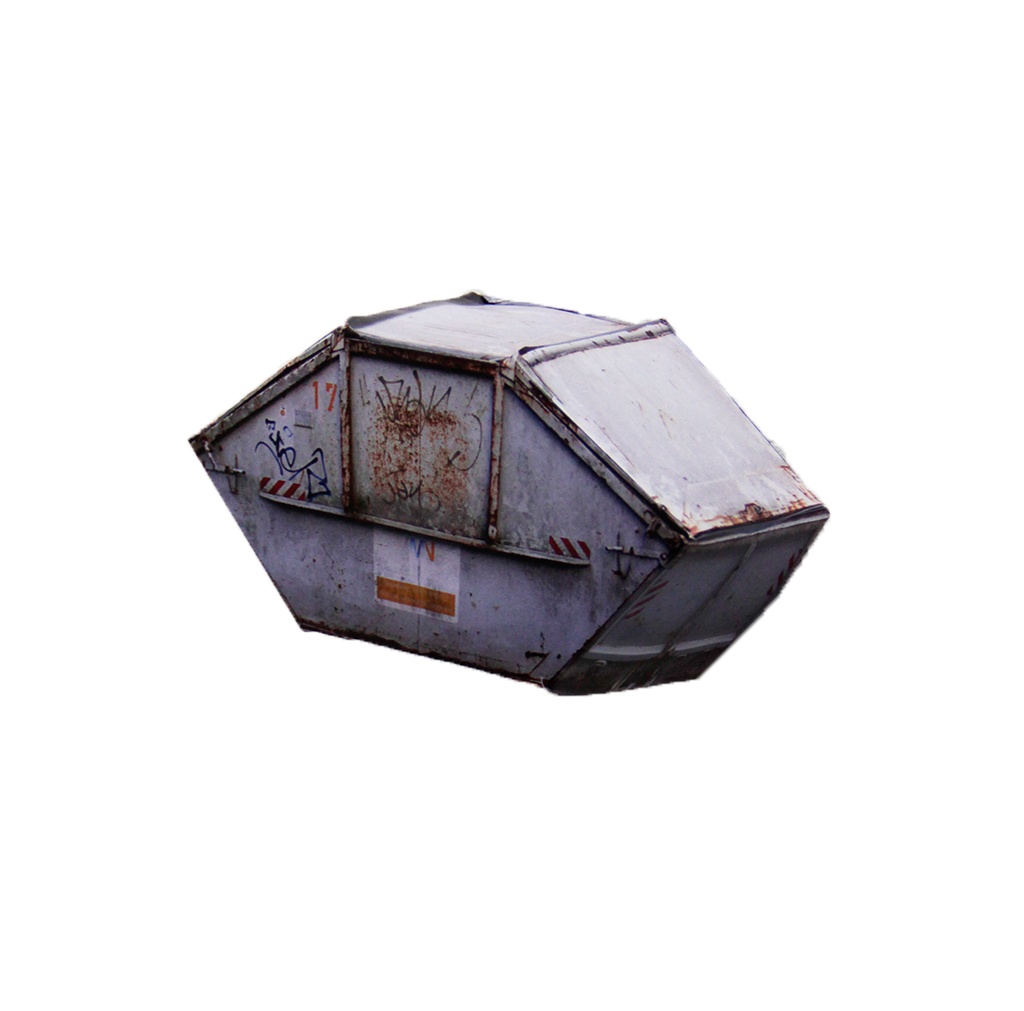
Ohne Titel (Abschluss), 2025
Photographie auf Hochglanzpapier, Karton, MDF
240 x 208 x 190 cm
Ausstellungsansicht; Abschlussausstellung bzw. Rundgang UdK 2025
/
Photograph on glossy paper, cardboard, MDF
240 x 208 x 190 cm
Exhibition view; graduation exhibition in the Berlin University of the Arts
Die Arbeit „Ohne Titel (Abschluss)“ zeigt (m)einen Arbeitsplatz bei Nacht. Gelbes Licht dringt durch die Fenster des Ateliers herein und der Platz steht wie so oft für sich allein.
Das gegenwärtige Gebilde ist ausgehend von hunderten Photographien, Weiterverarbeitung zum 3D Modell (Photogrammetrie), Vereinfachung der geometrischen Formen (Re-Topologisierung), erneuter Texturprojektion und schließlich durch Digitaldruck und Zusammensetzung der Drucke zu der jetzt sichtbaren Form entstanden.
Es entzieht sich damit völlig der ursprünglichen Benutzbarkeit (als Arbeitsplatz).
Die Aufteilung der jeweiligen Einzelteile zeigt den vom menschlichen Sehen abweichenden „Blick“ des Photogrammetrie-Algorithmus: Während der Mensch Gegenstände klar nach Wörtern und Benutzbarkeit voneinander abhebt, kleben Objekte im 3D Scan je nach Detailgrad aneinander.
Für das Gebilde im tatsächlichen Raum aber mussten wieder „echte Trennungen“ vorgenommen werden;
So liegt das Segment „Kleber“ auf dem Segment „Tisch“ – sind aber auch Teile des Tisches beim Segment Kleber und andersherum.
Der photographische Ursprung der Arbeit friert sie im Verweis auf einen exakten vergangenen Zeitpunkt ein.
Die Hüllenartigkeit der Faltungen weist auf eine Leere hinter dem Bild.
Es ist klar, dass die repräsentierten Gegenstände schon ausgezogen sind.
/
The work ‘Ohne Titel (Abschluss)’ / translated: Without Title (Graduation) shows my workplace at night. Yellow light streams through the studio windows and, as so often, the space stands alone.
The current structure was created from hundreds of photographs, further processing into a 3D model (photogrammetry), simplification of the geometric shapes (re-topologisation), renewed texture projection and finally digital printing and composition of the prints to form the now visible shape.
It thus completely deviates from its original usability (as a workplace).
The division of the individual parts shows the ‘view’ of the photogrammetry algorithm, which differs from human vision: while humans clearly distinguish objects from each other according to words and usability, objects in the 3D scan stick together depending on the level of detail.
For the structure in actual space, however, ‘real separations’ had to be made again;
Thus, the ‘glue’ segment lies on top of the ‘table’ segment – but parts of the table are also part of the glue segment and vice versa.
The photographic origin of the work freezes it in reference to an exact moment in the past. The shell-like nature of the folds points to a void behind the image.
It is clear that the objects represented have already been removed.